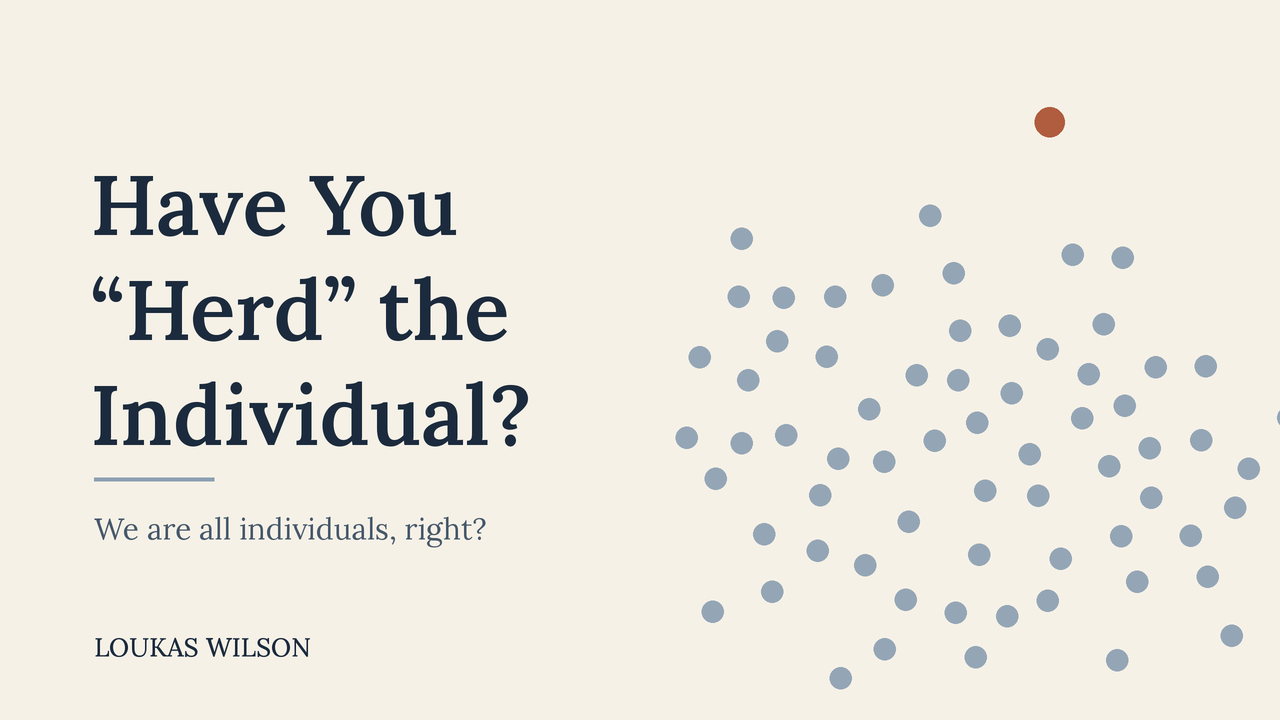
We are all individuals, right? You can't tell me what to do any more than I can tell you.
But think about the last time you agreed with someone. When I accept your opinion, I take what you said and make it mine. When you accept my thinking, you do the same. In that moment, whose idea is it? Could agreement, without consideration, be a temporary lack of individuality?
I don't think we ever stop being individuals, and we can always make our own decisions, as long as we are objective about the systems we're part of. Do we notice when our individuality is overridden?
A bee stampede
In a Templeton Ideas piece, "What's It Like To Be a Bee?", Joshua Moritz describes how a swarm of up to 10,000 honeybees chooses a new home. Hundreds of scouts search on their own, report what they found, and the article says "no scout is stifled." The decision comes from many individual reports, not from one dictator bee.
One researcher he draws on says these individual bees have real cognition. Andrew Barron argues that decision-making is at the core of cognition, and that a bee weighing a flower's reward against its risk is thinking. Pierrick Bourrat asks where individuals come from in the first place. In his account, when parts join a larger whole, they come to depend on each other, and the conflict among them drops. The whole starts to act as one.
That made me ask a question the article doesn't answer. A bee is still a bee inside the swarm, just as a person is still a person inside a crowd. So is that bee an individual?
My answer is yes, up to a point. A bee seems to decide for itself about flowers and about sites. But what if the bee felt the pull of the colony against its own judgment? The article says bees will sometimes give their lives for the hive. Then its own judgment would give way to the swarm. The bee is an individual until it isn't but it's not given up for good.
On logic
People choose their jobs, where they live, and how they dress. Those look like individual choices.
So when my individuality says I want to dress for a ballroom on my trip to the arctic. Logic tells me, it will be cold and a winter jacket it is. I could still wear what I want, and it would be my choice, but think of what happened. The logic narrowed the possibilities and won the argument. As soon as, "it will be cold" is in my head, a whole array of possibilities stop showing up at all. The programming I carry, from experience, upbringing, and instinct, decides which options I will ever see.
When I accept your idea without considering the meaning of it, the same thing happens. The reasoning feels sound, so I stop looking for other options. We are individuals, but only up to the point where what we've learned decides what we notice. The question is where that point is.
All go
When a herd stampedes, not every animal decides to run but the herd runs anyway. The decider is fear, and the logic of staying with the group, the one who stops is the one who gets caught.
The bees show the other side. A swarm decides together, and according to the article no scout is stifled, because every scout brings her own information. A herd goes where the first few go. The difference is whether each member is still thinking.
The job we despise
Many people work jobs they despise in order to survive. Are they individuals?
I think they are, but look at what they've done. They embrace the logic of survival, and they do it at the expense of their own individuality. The reasoning is sound, the bills have to be paid. So it doesn't feel like a loss, it feels like being sensible, an agreement to take part in the system.
Their individual capacity hasn't gone, but it's swept aside by logic, like the bee's. That's what makes the next question hard.
What is the motivator?
What pushes us to the edge, to the point where we could go against the group, the job, or the logic? And what holds us back?
Fear, survival, belonging, and logic each motivate us, but motivation is more than what drives us. It's also how influence shapes what we're able to see. The logic that says it will be cold doesn't just push us toward a choice. It decides which choices we notice at all. Do we judge an outcome by money, or by habit, without ever noticing the habit?
That's why I think the first step is to notice. A person who can say "I'm doing this out of fear" or "this is what I was taught to see" regains some of the choices, even if they decide to keep the same decisions. When we recognize our own place in the system and that our decisions are our own but in the context of something else, we are truly individuals.
Source: Joshua Moritz, "What's It Like To Be a Bee?", Templeton Ideas, which draws on the work of Andrew Barron and Pierrick Bourrat.
Loukas Wilson is a coach and the founder of True Self Horizons, which builds tools to help people reflect on their own patterns. He resides in Maine.
If this landed, here is how coaching works or start with a free worksheet.